

22 VENDOR SUBMISSIONS | 19.8K PAGES EVALUATED | 108 PRICING CATEGORIES | 11 SMEs SUPPORTED | 9 min VS. 6–9 MONTHS |
|---|
AT A GLANCE | |
|---|---|
Customer | Major US utility (identity withheld under confidentiality) |
Procurement | Enterprise Engineering Services RFP spanning 6 lines of business |
Field | 22 vendors responded; average response length ~900 pages (~19,800 pages total) |
Pricing complexity | 6 separate pricing sheets, 108 distinct pricing categories; vendors bid selectively — not all submitted pricing for all 6 lines of business |
Evaluation team | 11 subject-matter experts on the technical evaluation, supported by HillStar; financial evaluation of this scale typically occupies 4 analysts over a 6-week pricing review |
Result | Complete side-by-side evaluation with full evidence traceability, benchmarked against industry rates and the utility’s own historical data — in 9 minutes |
THE SITUATION: AN EVALUATION NO TEAM CAN READ
The customer, a major US utility, issued one of its largest procurements: an enterprise Engineering Services RFP covering six distinct lines of business. The response was overwhelming by design — 22 vendors submitted proposals averaging roughly 900 pages each, nearly 19,800 pages of technical narrative, qualifications, and commercial detail. Pricing alone was a matrix problem: six separate pricing sheets spanning 108 distinct pricing categories, with vendors bidding selectively — some competed across all six lines of business, others in only one or two — so no two submissions were directly comparable out of the box.
Evaluated the traditional way, a procurement of this size stretches over six to nine months[1]. The 11 subject-matter experts would spend weeks reading and scoring thousands of pages by hand, while a separate financial evaluation of this scale typically occupies 4 analysts for roughly six weeks — normalizing 108 pricing categories across six sheets and building the side-by-side comparison. The cost is not only the calendar. Over that many pages and that many months, evaluation quality drifts — fatigue sets in, criteria get applied unevenly, evidence for a given score becomes impossible to locate months later, and the eventual award must still withstand regulatory and protest scrutiny.
This is not a HillStar estimate. The World Bank’s Independent Evaluation Group, reviewing procurement across its portfolio, documented bid-evaluation cycle times ranging from roughly 288 to 900 days for complex procurements[2] — confirming that the multi-month evaluation this utility faced is the norm for complex RFPs at even the most process-mature institutions, not an outlier. |
|---|
WHAT HILLSTAR DID
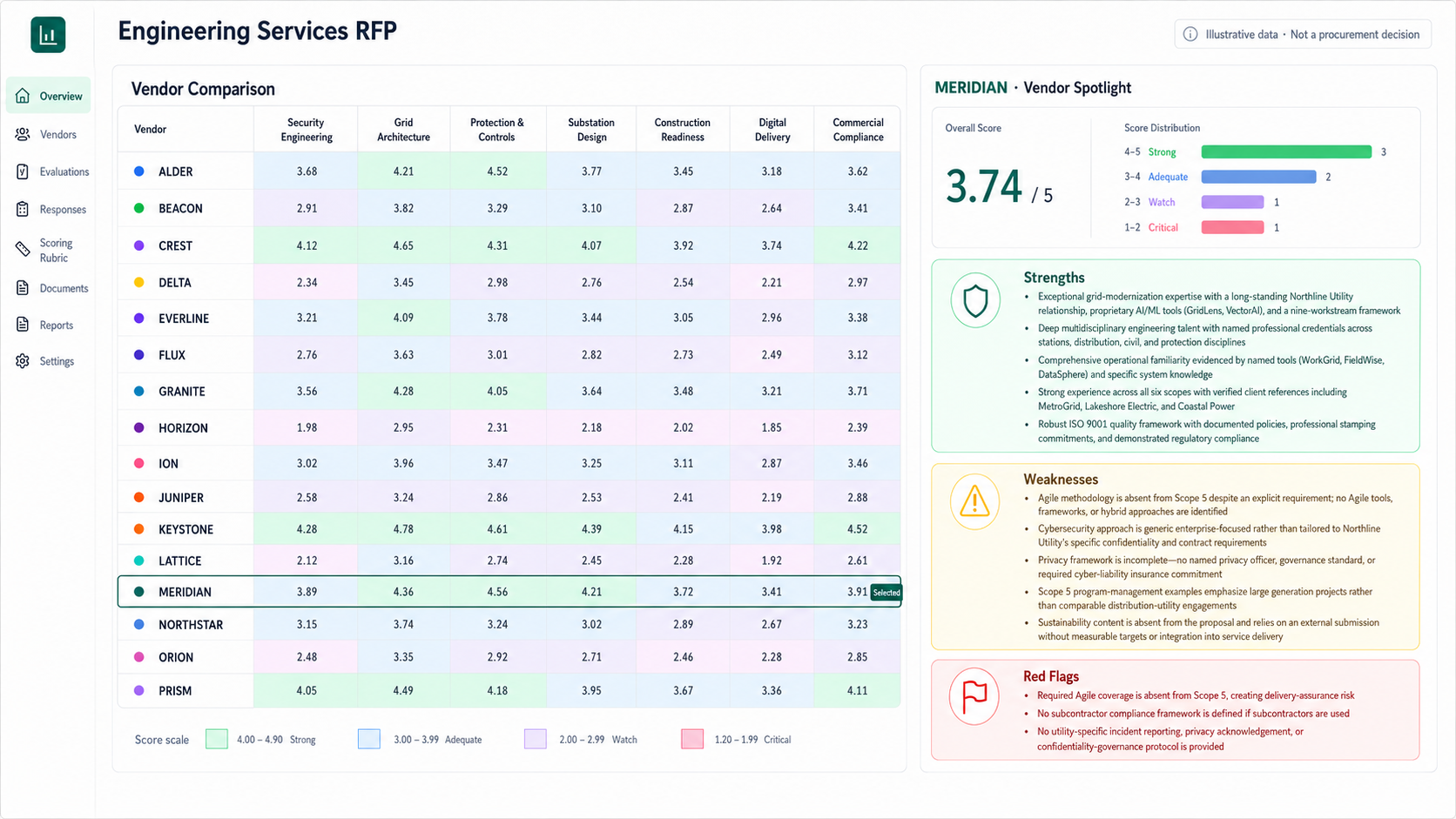
HillStar ingested all 22 submissions against the utility’s own RFP structure and evaluation framework and put a complete, evidence-linked evaluation in front of the utility’s 11 subject-matter experts in nine minutes. The experts stayed in control of the decision — HillStar did the reading, extraction, and comparison so their judgment could be applied to the findings rather than spent locating them.
Technical Requirements Analysis
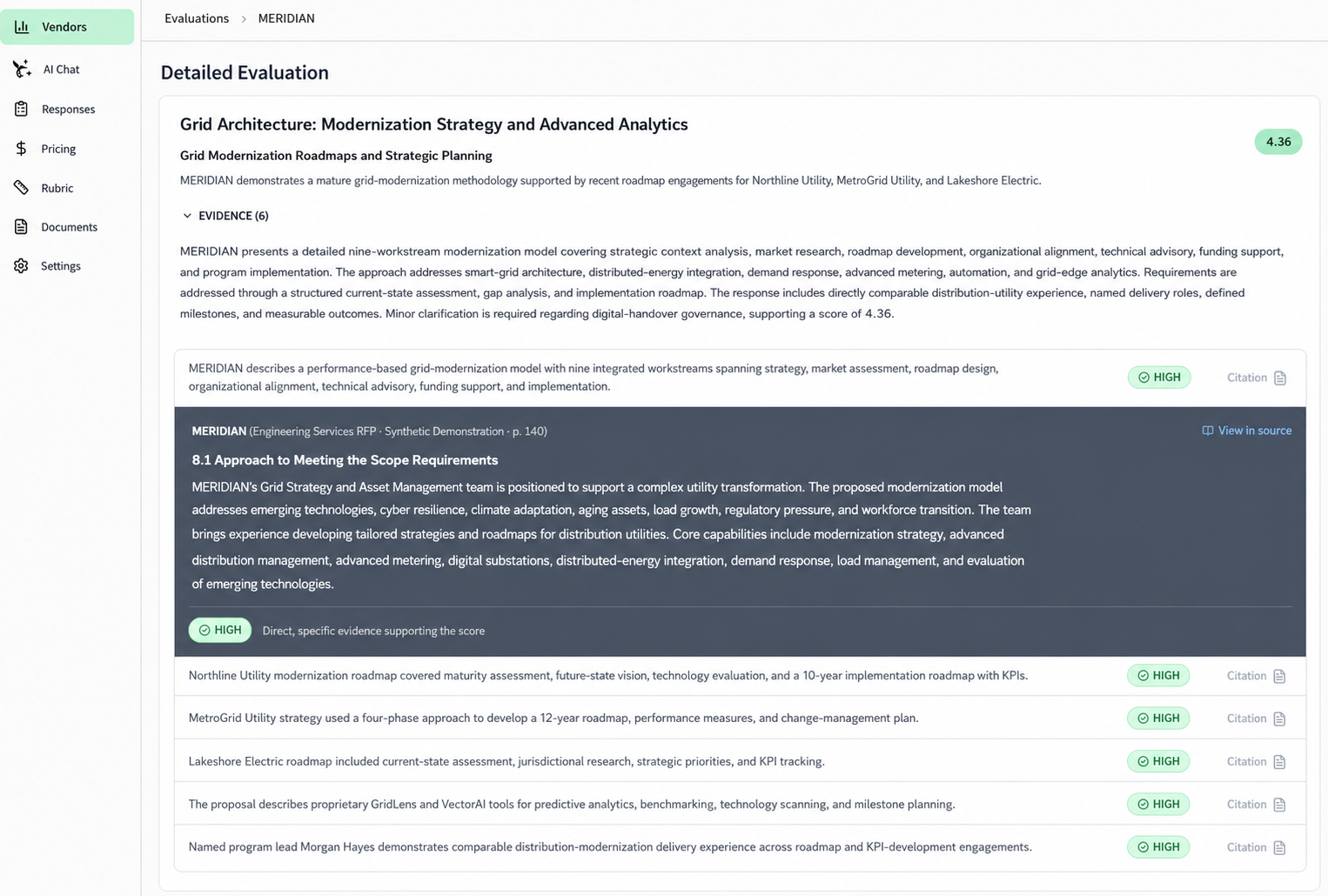
HillStar extracted and normalized technical requirements across all six lines of business and read every one of the ~19,800 pages against them — preserving full source traceability. It built a side-by-side comparison table in which each vendor’s response to each requirement sits in one row, with every extracted value linked back to the exact page of the vendor’s document it came from. The selective-bidding problem dissolved: HillStar mapped each vendor only to the lines of business it actually bid, so evaluators could compare like against like without manually untangling who competed where.
Compliance & Evaluation Alignment
Every response was scored against the utility’s procurement requirements, mandatory criteria, governance standards, and organization-specific evaluation framework — the same rubric applied identically to all 22 vendors. Missing qualifications, unanswered requirements, and gaps in coverage across the six lines of business were flagged automatically, eliminating the uneven, reviewer-dependent scoring that creeps into any months-long manual process.
Risk & Evaluation Intelligence
HillStar surfaced technical gaps, contractual risk, compliance exceptions, unsupported claims, and evaluation inconsistencies across the field — each with severity and a source citation. Across 19,800 pages these are precisely the items a fatigued committee misses: a capability asserted in an executive summary but unsupported in the technical body, exception language buried deep in commercial terms, or a vendor strong in one line of business quietly under-qualified in another it also bid.
Commercial & Financial Analysis
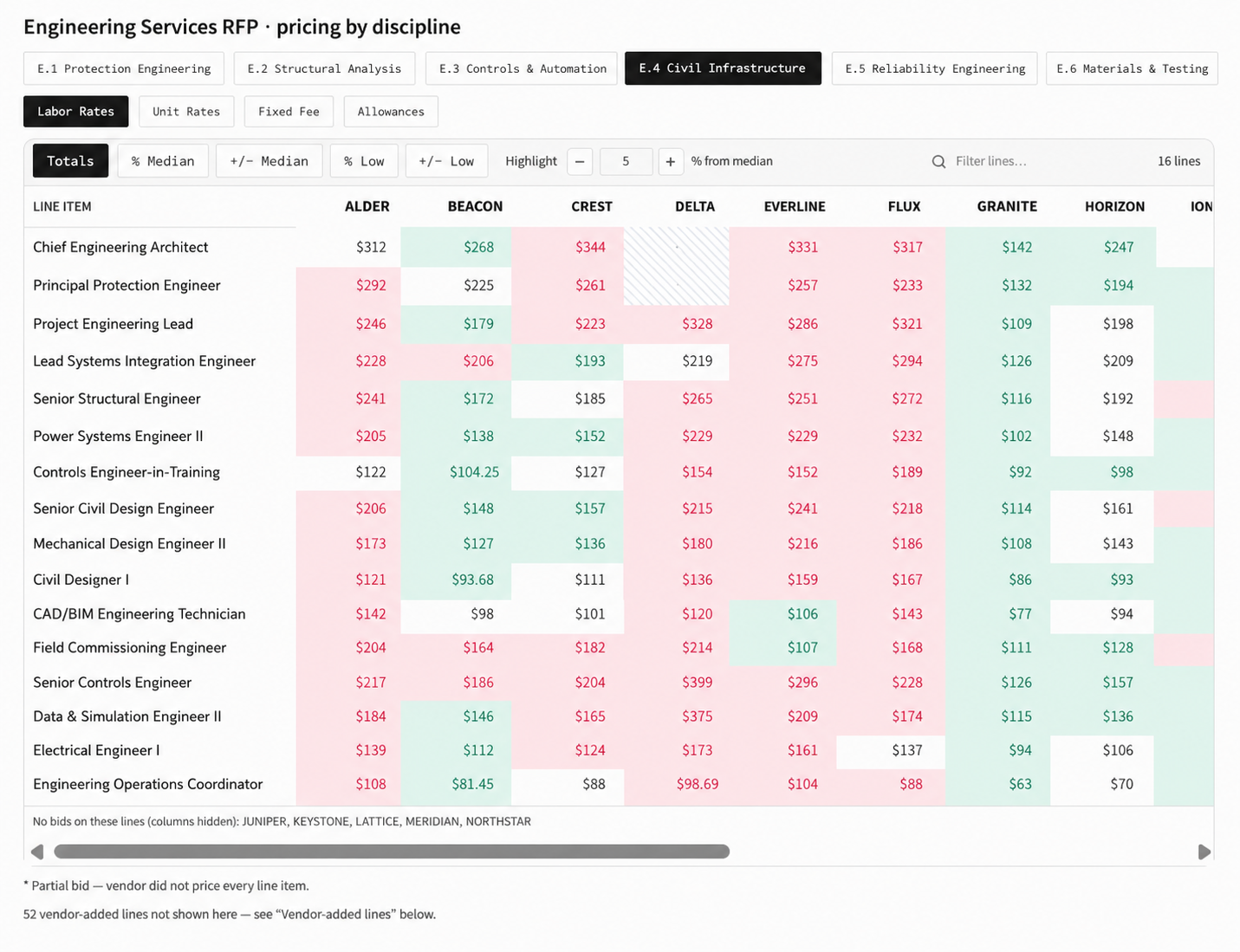
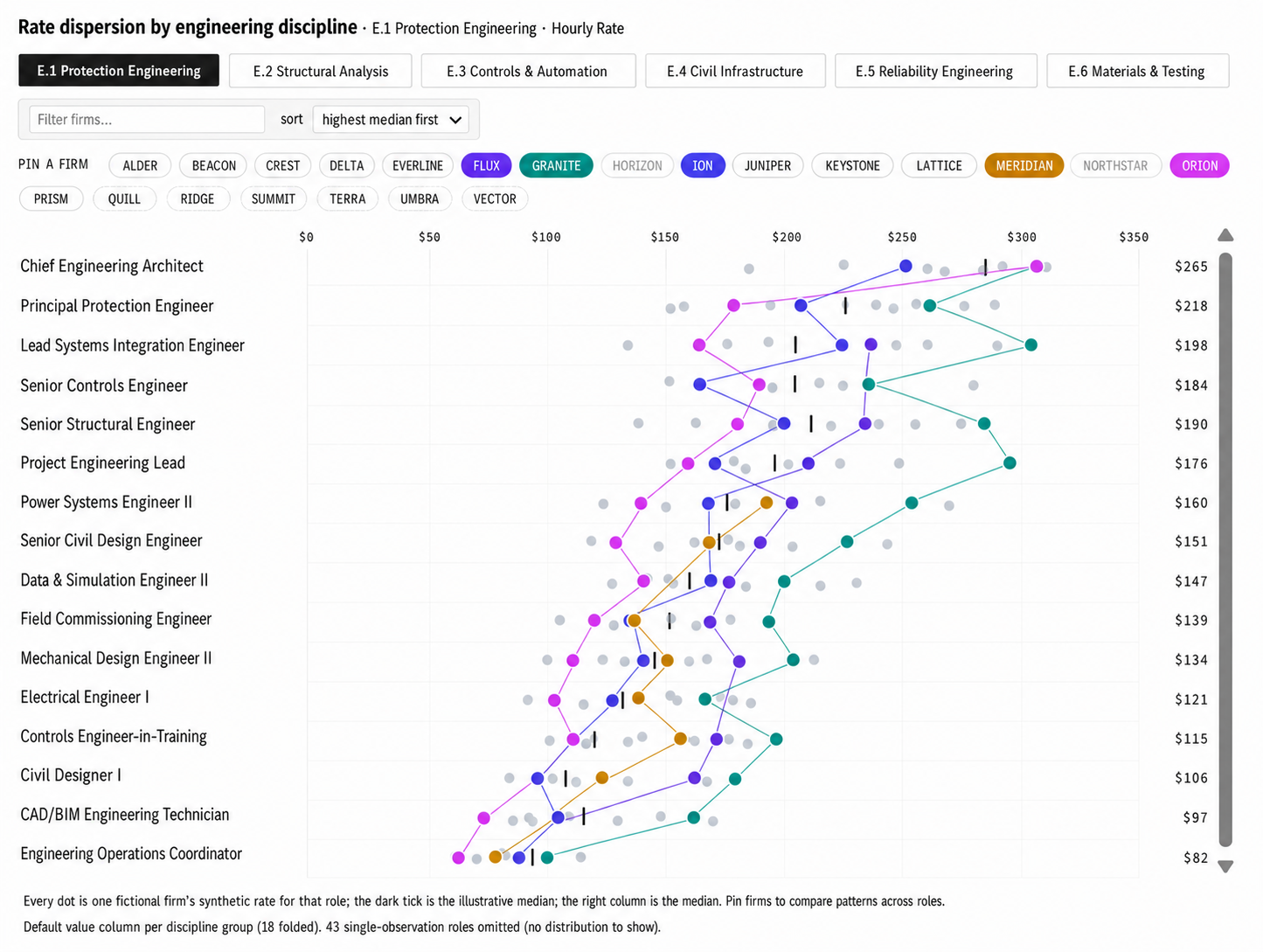
HillStar reconciled all six pricing sheets and 108 pricing categories into one normalized commercial view — a financial evaluation that at this scale typically occupies four analysts for six weeks — handling the fact that vendors priced different subsets of the work. Crucially, pricing was double-benchmarked — against prevailing industry rates and against the utility’s own historical pricing data — so the experts could immediately see not just which bid was lowest, but which was reasonable, which was an outlier, and where a category had drifted above the utility’s historical norms.
RESULTS
Traditional evaluation | With HillStar |
|---|---|
11 SMEs spend weeks reading and scoring by hand | 11 SMEs review a complete, evidence-linked evaluation in 9 minutes |
Separate financial review: 4 analysts, ~6 weeks | All 108 categories normalized and double-benchmarked in the same 9 minutes |
Thousands of pages read manually; evidence hard to relocate later | All ~19,800 pages read; every score linked to its source page |
Comparison spreadsheets hand-built; selective bids reconciled by hand | Automated side-by-side table, vendors mapped to the lines of business they bid |
Scoring drifts across many reviewers over many months | One rubric applied identically to all 22 vendors; inconsistencies flagged |
From two quarters to a coffee break. Collapsing a six-to-nine-month evaluation into nine minutes does more than save cost — it changes what the utility’s experts can do. Their 11 SMEs spent their time applying judgment to a complete, evidence-backed picture instead of hunting for facts across 19,800 pages. The award moves forward while pricing is still current, and the entire evaluation is audit-ready the moment it completes, with every conclusion traceable to the vendor’s own words. Speed, at auditor-grade rigor, with the experts firmly in control.
References
- Traditional six-to-nine-month evaluation cycle reflects HillStar’s experience with enterprise engineering-services procurements of comparable scale.
- World Bank Independent Evaluation Group, “The World Bank and Public Procurement — An Independent Evaluation,” Volume II (2014). Documents bid-evaluation cycle times ranging from approximately 288 to 900 days for complex procurements. ieg.worldbankgroup.org