

4 VENDORS EVALUATED | #1 ON PRICE — NON-COMPLIANT | 2 of 4 MISSING MANDATORY CERT | Minutes TO VERIFY VIA AI CHAT | Averted MIS-AWARD RISK |
|---|
AT A GLANCE | |
|---|---|
Customer | A large publicly-owned (municipal) electric utility (identity withheld under confidentiality). |
Procurement | Competitive RFQ for next-generation firewalls protecting the utility's OT/SCADA network. |
Field | Four pre-qualified vendors submitted quotations across technical, commercial, and compliance criteria. |
The risk | The lowest-priced quotation was on track to win — but was missing a mandatory signed price certification (Schedule G). |
Outcome | HillStar flagged the gap; the committee confirmed the requirement in minutes and knew exactly what to require before shortlisting. |
THE SITUATION: CHEAPEST ISN'T THE SAME AS AWARDABLE
A large publicly-owned electric utility ran a competitive RFQ to replace the firewalls guarding its OT/SCADA network — the cybersecurity backbone of a regulated grid operator. Four pre-qualified vendors responded. Working through the submissions, the evaluation committee kept returning to one vendor — Company X — whose pricing was complete, itemized, and aggressively discounted. On cost alone, it read like the winner.
But cost only counts once a bid is compliant. Like most regulated procurements, the RFQ states plainly that quotations failing a material requirement will not be considered. One such requirement is a mandatory signed price certification (Schedule G) — a single declaration easily lost among hundreds of pages of pricing tables, delivery commitments, and supporting reports. A submission can look thorough and still omit it. Under the pull of an attractive price, that is exactly the kind of gap a committee overlooks — and exactly the kind that unravels an award months later.
WHAT HILLSTAR SURFACED
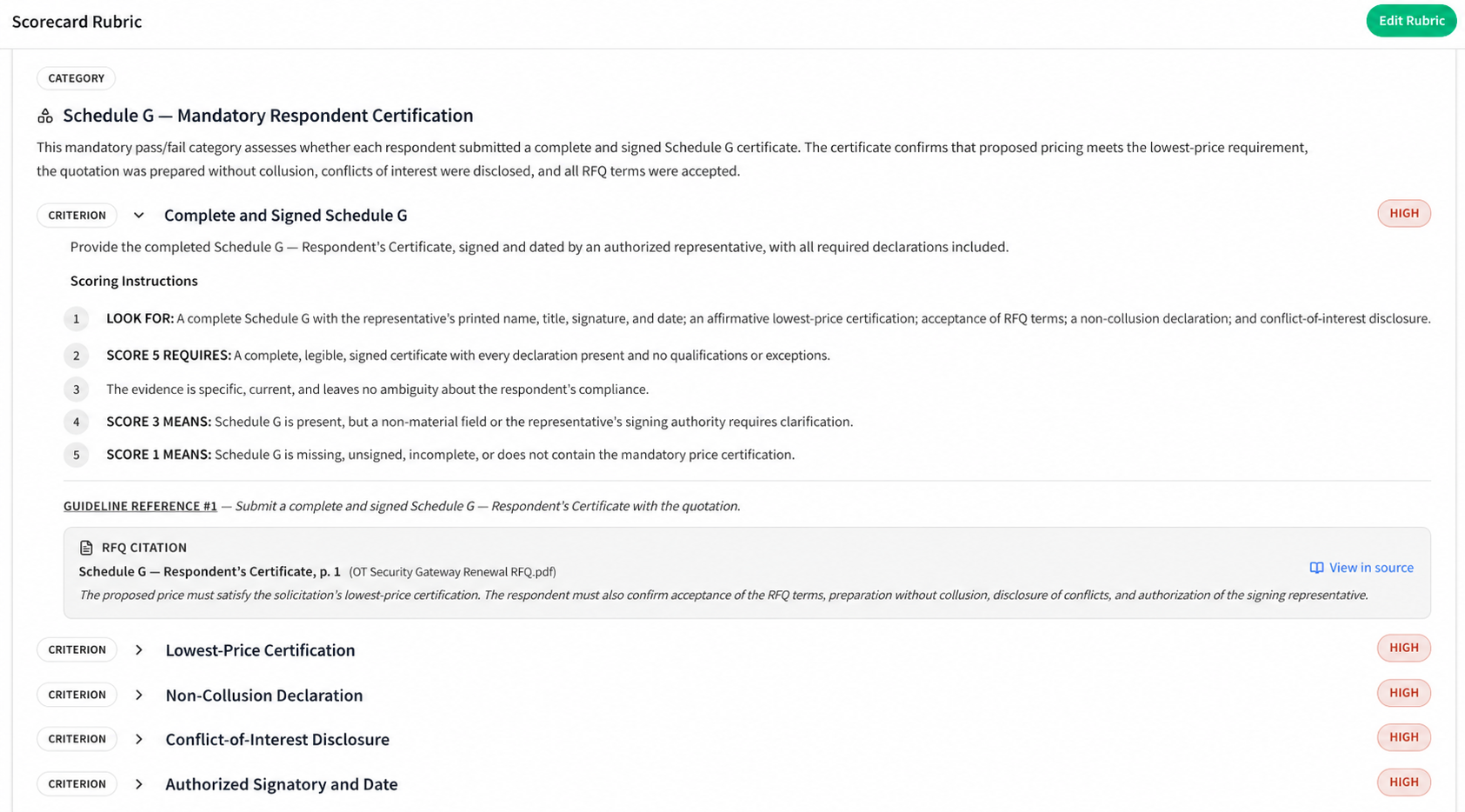
HillStar had already evaluated all four submissions against the utility's own rubric. For Company X, it scored the pricing strengths honestly — and, on the same screen, flagged the missing certification as both a weakness and a red flag, alongside the absence of OEM authorization and independent references. The red-flag panel put it plainly: without the signed price certification, the utility could not certify compliance with the lowest-price requirement, so the low bid could not be awarded as submitted.
HillStar's evaluation view for the lowest-priced vendor — strong pricing (left) beside the compliance gaps (center) and the award-blocking red flag (right), all on one screen. Aliased for confidentiality.
HOW THE TEAM USED THE AI CHAT
Surfacing a flag is only half the value; the committee still needed the exact requirement and the remedy. A procurement analyst asked HillStar directly:
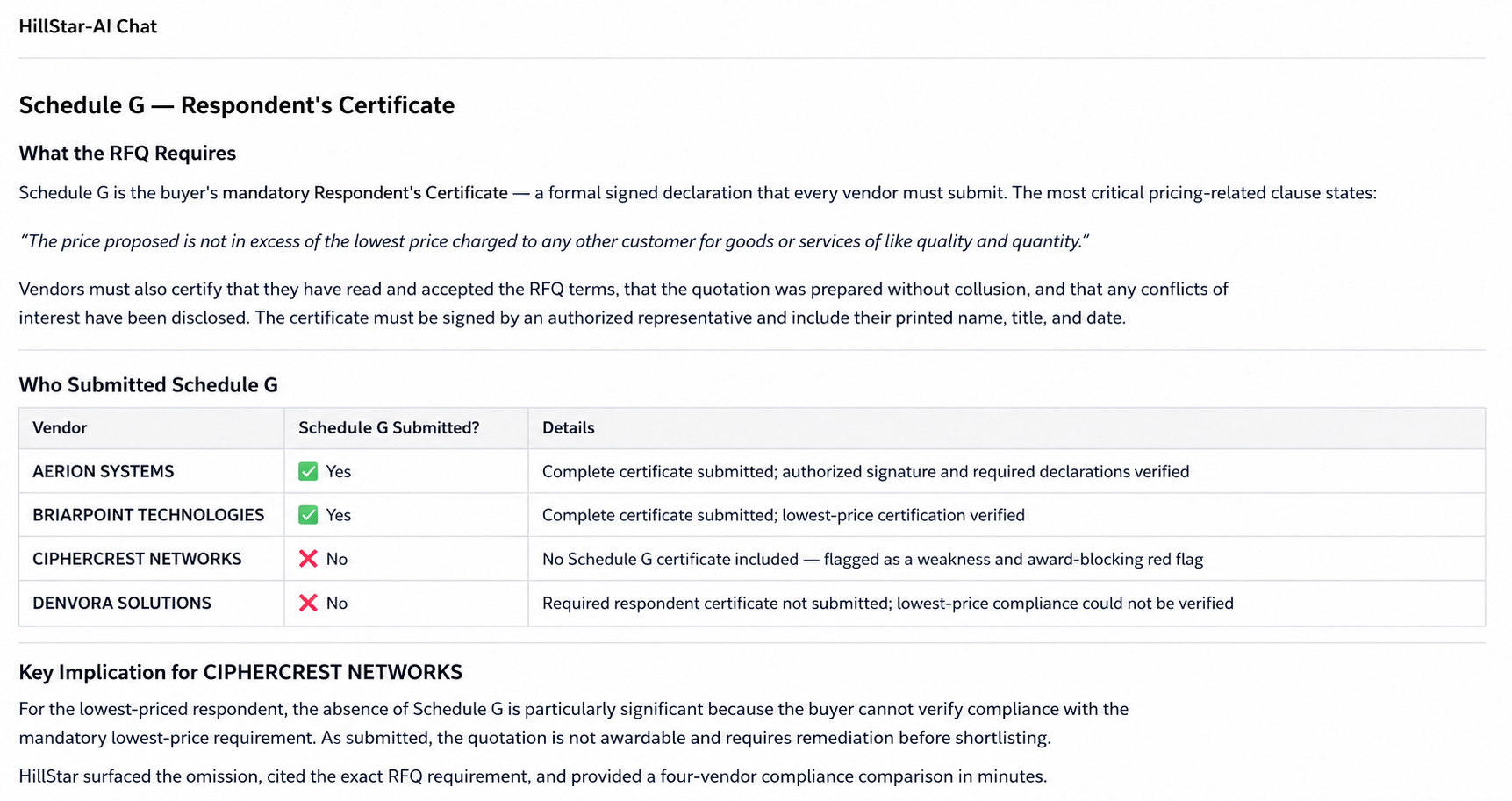
“give me information on who has the Schedule G certification and what is the RFP verbiage requirement on it”
In a single pass, HillStar read the statement of work and the vendor comparison, located the exact Schedule G language in the RFP, and checked all four submissions against it — returning the precise requirement and a side-by-side compliance picture: two vendors had filed the signed certificate; two, including the low-price front-runner, had not.
The analyst's question, HillStar's investigation, and the four-vendor compliance answer — with the exact RFP clause cited. Aliased for confidentiality.
That answer did two jobs at once. It confirmed the low bid was not awardable as submitted, and it spelled out exactly what to require before the vendor could be shortlisted: a signed Schedule G price certification, OEM authorization, and independent references. The judgment stayed with the committee — HillStar simply made the requirement, and the fix, impossible to miss.
RESULTS
WITHOUT HILLSTAR | WITH HILLSTAR |
|---|---|
A missing signed form, easy to overlook behind an attractive price. | Missing certification flagged as a red flag on the same screen as the pricing. |
Committee leaning toward the lowest bid on cost. | Committee shown the low bid was non-compliant before shortlisting. |
Hours of manual RFP cross-referencing to confirm the requirement. | Exact clause and four-vendor compliance status returned in minutes via chat. |
Risk of awarding a non-compliant bid — exposed to challenge and protest. | Award defensibility protected; precise remediation requested from the vendor. |
INDUSTRY CONTEXT Independent authorities are converging on the lesson this evaluation illustrates: complex procurements need expert-grade review, not a checklist a generalist can run alone. A Harvard–UCL study of government AI-procurement checklists concluded that the knowledge of a generalist reviewer “even when augmented by an AI procurement checklist will simply not be enough,” and that transparent, auditable records are needed to catch what any single reviewer misses.[1] In parallel, the U.S. General Services Administration and NIST’s Center for AI Standards and Innovation have announced a joint effort to build clearer AI evaluation guidelines and checklists for federal procurement.[2] HillStar delivers precisely that — expert-grade, citation-linked evaluation — today. |
|---|
Faster is the headline; defensible is the point.
For a regulated, publicly-owned buyer, awarding to a non-compliant vendor invites bid protests, freedom-of-information scrutiny, and findings that can unwind the award entirely. HillStar surfaced the one gap that mattered, cited the exact requirement, and left an auditable record behind every finding — turning a buried omission into a decision the committee could see, understand, and act on in minutes.
References
- T. Zick, M. Kortz, D. Eaves & F. Doshi-Velez, “AI Procurement Checklists: Revisiting Implementation in the Age of AI Governance,” 2024. arXiv:2404.14660.
- “GSA and NIST Partner to Boost AI Evaluation Science in Federal Procurement,” U.S. General Services Administration announcement.